Reading the Rows in Your Breaker Panel
A breaker panel is not just a row of switches. It is a map of every circuit in the building.
September 2, 2026 · 4 min read
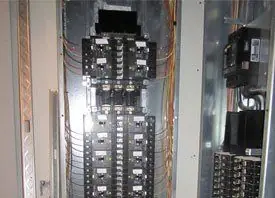
Most people go their whole time in a house or a building without ever opening the breaker panel except to flip something back on after it trips. That is fine, most of the time there is no reason to look closer. But it helps to know what you are actually looking at when you do open that door, because a panel is not just a row of switches. It is a map of every circuit in the building, and reading it a little can tell you more than you would expect about what is going on behind your walls.
What the rows of breakers represent
Each breaker in the panel is tied to one circuit, a run of wiring that feeds a specific set of outlets, lights, or a piece of equipment somewhere in the building. A well labeled panel will tell you roughly what each one covers, kitchen, bedroom, water heater, and so on. An unlabeled or poorly labeled panel just gives you a row of switches and no way to know what any of them actually do without testing. If you have ever stood in a hallway flipping breakers one at a time trying to find the one that controls a single light, you already understand why labeling matters, and why it is worth having done properly rather than guessed at.
The size of a breaker, printed right on the switch itself, tells you roughly how much a circuit is built to carry before it trips. That number is not arbitrary. It is matched to the wiring behind it and to what that circuit is meant to power. A breaker that trips once in a while under a heavy load, several things running at once on the same circuit, is usually just doing its job. A breaker that trips repeatedly with nothing unusual plugged in is telling you something is worth a closer look.
What a full panel looks like
Panels have a limited number of slots, and older buildings especially can end up with every one of them filled, sometimes with additions squeezed in over the years as more circuits got added for a new appliance or a remodeled room. A full panel is not automatically a problem. But it does mean there is no room left to add anything new without changing something, and it is worth knowing that before you are standing in a hallway deciding where a new circuit for a workshop or an addition is going to come from.
What is worth a call
A breaker that will not stay reset, warmth or discoloration around the panel itself, a burning smell near it, or breakers that trip with no clear cause are all things worth having looked at rather than living with. So is a panel that is decades old and clearly was never updated as the building around it changed. None of these things need to be an emergency to be worth a call. They are just the kind of thing that is better looked at on a normal weekday than ignored until it becomes something bigger.
- A breaker that keeps tripping with nothing unusual running
- Warmth, discoloration, or a burning smell near the panel
- A panel that is clearly decades old with no updates
- No room left for a circuit you know you will need soon
- Labels that no longer match what is actually on each circuit
Why the panel is worth understanding at all
None of this is about turning anyone into their own electrician. It is about being able to describe what is actually happening when you do call one. Telling someone on the phone that a specific breaker keeps tripping, or that the panel has felt warm to the touch near one particular row, gives them something real to work from before they ever step through the door. Compare that to just saying the power keeps going out somewhere in the house, which could mean almost anything. A little familiarity with what the panel is actually doing turns a vague problem into a specific one, and specific problems get solved faster.
It also helps to know that a panel getting old is not, by itself, a failure of anything. Buildings age. Families and businesses add appliances, remodel rooms, and put more load on a system that was sized for a different set of habits decades earlier. A panel that made sense in 1974 was sized for 1974. Recognizing when a panel has quietly outgrown the building around it is less about anything being broken and more about noticing that the building's needs moved on while the panel stayed the same.
Baker Electric has been looking at panels around Lubbock since 1974, in buildings old and new, and can tell you plainly what is worth doing something about and what is not. Call (806) 794-4683, Monday through Friday, 8 to 5.
Baker Electric Inc. — (806) 794-4683
Call (806) 794-4683More articles
How a Lubbock Shell Gets Wired, Start to Finish
Before a building looks like anything, the wiring inside it already has to be right.
Why an Electrician Ends Up Out at the Well
Out past the edge of town, a well depends on wiring built to survive weather and distance nobody checks on daily.